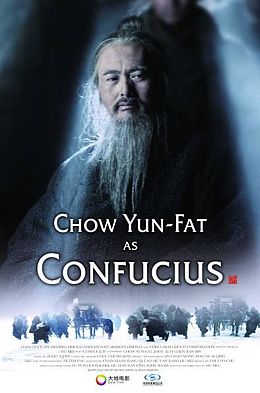
In 2009, one of the most 'eye-catching' events that highlight the revival of Confucianism could be the release of the movie 'Confucius'. The Hong Kong actor Chow Yunfat plays the role of Confucius. I am still looking forward to the releasing of this film in the US, so that I'll have the chance to see it. ( <The Confucius>, directed by Hu Mei)
In September, I went back to Hong Kong to see a showing of another movie about Confucius directed by Fei Mu, one of the leading film directors of China before 1949. The film was lost for decades and had recently been restored by the Hong Kong Film Archive.

I am not a film aesthetic person nor a film critic. However, what interested me are the socio-historical context and how it related to the cultural and social symbolic meanings of these two films. I am all ready for serious work for comparison, but I can only do that when I have the chance to see the 2009 version of 'Confucius'.
To look at the historical context, 1938-40 when Fei Mu's version was being made and released, China was still in the middle of WWII with Japan. The message of yearning ( for peace; for a 'savior' for the nation; for 'restoration' of the 'values') and condemning (war; traitors; the fall of morality) were not subtle at all in the movie. And it made so much sense once you look at it together with the historical context.
2009 -- China is 'rising' to be one of the largest economic powers in the world. There is no war (at least, not for the Chinese). Yet, Do they still need a 'savior' to salvage their declining morality? if so, is Confucius the person to do so? I doubt it. Not that I disagree that the Confucius is lack of the cultural capital to do so (and his possibility being transformed into the ultimate moral symbols for the nation by those who are able to). I just don't see that the current regime (who also control the film industry, btw), will allow Confucius to be transformed as such role in a movie. And by 'such role', I mean, a sacred sage for the nation.

The sacredness of Confucius in Fei Mu's version can be found at the very beginning of the film -- in which the birth of Confucius was being narrated together with the birth of Jesus and Buddha. Throughout the film, Confucius always dominated in the 'sacred' places among his students (on top of the hill; on top of teaching altar etc) and the kind of suffering they experienced together after Confucius decided to travel around and preach his teachings is (to me, at least) highly resembled the kind of master-disciple sufferings that we read in the bible story. A normal citizen was being tortured and killed, and he cried out 'Oh Heaven*! Please send a sage to save us the people!'. And this sacred role of the Confucius is further reinforced towards the end of the film, with a song dedicated to Confucius that says 'Confucius, Confucius, the Great Confucius! your teachings will be passed on for thousands of generations, and it will be around in this world'.
Portraying the sacred does not make Confucius 'other-worldly', after all, he is still human. In fact, in Fei Mu's version, the story of Confucius continue -- he failed his preaching work, returned home, and suffered the loneliness of aging (when most of is disciples left and only his grandson had stayed with him). He did not got raised up to the Heaven by the supernatural power and left this world, he stayed here and suffered just like all of us. And that probably added the sacredness to the morality that he preached, as he had stood firm to it with his life.
I wonder how the same story will be told in the 2009 version. Or, would it be a 'same' story at all. Can these sacredness still exist? I seriously doubt it. The meaning of 'being religious' had been transformed drastically since 1949 in China. The inferiority of being religious is not just condemned by the elitist intellectuals of the Chinese Enlightenment era that highly influenced by secularism, but it is administratively challenged under the atheistic regime. Marxist scholars, including the recently deceased and former chairperson of the Institute of World Religions in the Chinese Social Science Academy Ren Jiyu, had identified that Confucianism is a religion. Therefore it is as problematic as the other religions and required strong administrative order (if not complete destruction, like what happened during the cultural revolution) to control it. As Julia Ching states, 'Marxist scholars have shown sensitivity for discerning religious directions and sentiments in tradtional philsophical teachings. Presumably, this effort is motivated by the insistence on atheistic humanism, accompanied as this is by the need t osearch out religious trends if only to manipulate or oppose them' (Ching 1990: 126).
Since sacredness easily give people (especial social scientists like US!) the impression of 'religious' (and does constitute the quality of being religious, sociologically speaking), it is alarming to have too much of it. So what kind of 'Confucius' they will portray in the movie? or to put it in a profane way, will Confucius have an affair with Nanzi in the movie? I can't wait to see!!
More reviews of the 2009 Confucius:
http://www.youtube.com/watch?v=YgiM1ubNCYc -- Trailer
Reference:
Ching, Julia. 1990. Probing China's Soul: Religion, Politics, and Protest in the People's Republic. San Francisco: Harper & Row.


