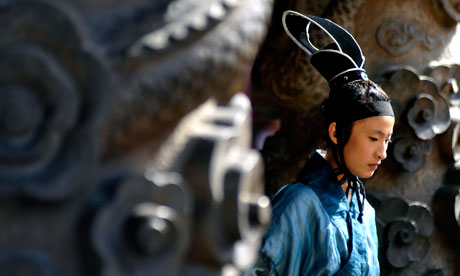
 It had been four years since I first follow on the reports about the worship of Confucius' Birthday on 28 September. The high point, I have to say, was still 2007. The vibe was extremely strong back then -- not only because of the fact that it was my 'fresh' and 'new' discovery of this bizarre return of Confucianism in post-reform China. The context was different back then -- it was the year before the Olympics, and the state is working so hard to recreate Confucius as the cultural symbols for the nationalistic 'sports' event (they announced the five-selected-verses from the Analects as one of the slogans for the Olympics). The UNESCO was established in 2005 but actually presented the award for the first time in 2007, also added the excitement for this 'international' event. But above all, the direct funding from the Central Government sponsoring the rituals and 'upgraded' that as 'state event' , I believe, explains the significance of the event.
 Journalists and scholars had a lot to say about the ritual in 2007. From the 'vacuum of Marxism' to the 'return of Confucianism', everyone has their opinion to raise even though no one can tell us (back then, at least) how the revival of Confucianism is ACTUALLY HAPPENING among the people. What happened outside of the ritual hall that only invited special guests were allowed to participate? (since I've tried to find a way to get 'inside' but failed to do so, with my foreign-graduate-student-with-no-connection status -- why the pity-the-student card doesn't work for me?).
2008, the vibe was still high. It's just few weeks after the Olympics, tourists are still lingering around China and it's one of the must-go 'cultural event'.
2009, mmm, I don't remember I see much report on that anymore, especially in the out-of-China media. That was the year when I tried to get access to the ritual in Qufu but failed to do so.
2010, what they have to say about the ritual? Up to now I still haven't found anything report on the Qufu rituals yet. I saw news about the Taiwanese rituals, performed by the President Ma Yingjiu (and then, people outside fighting for the 'wisdom brushes' for calligraphy, not quite sure where the transcendent power is coming from that granted the 'wisdom', since it's just a 2 minutes-segment in the evening news). And the Guardian has this report -- and it focuses on the resume of rituals in the Beijing Confucius temple and not the large cultural event in Qufu. But other than that, it seems that the 'Confucian teacher' and the scholar of Confucianism has nothing new and exciting to tell us. The narrative remains the same for the past few years -- state need new symbols for legitimacy; rapid social change created yearning for new ethical and moral guidance/anchor; it's something 'rooted' in Chinese people's mind and it's about time for it's return...
The kind of reporting is still remaining at the superficial level -- scratching the surface, highlighting the visual and the meta-narratives (which almost became too convenient to make as it had been the same for the past few years) without actually telling us the complexity of the revival of Confucianism in China more than 'the musician' who found it not that personally appealing. I know it's 'just' a newspaper report, but isn't it about time to develop some more insight into the phenomenon?
Picture of Children reading the Analects of Confucius at the Confucius worship in Tianjin from the Xinhua News. (source: http://news.xinhuanet.com/english2010/china/2010-09/28/c_13534300_4.htm)


