Tuesday, September 28, 2010
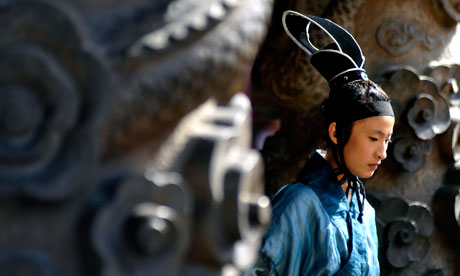
It's another year, what they have to say about the Confucius Birthday?
Friday, August 27, 2010
Confucius Invasion?!
Read more:http://www.sgvtribune.com/ci_15909074#ixzz0xqsXxF1v
Education
INDUSTRY - Tension surrounding Hacienda La Puente Unified's plans for a Confucius Classroom accelerated Thursday night as vocal opponents of the Chinese government-funded program threatened a recall and one board member has secured a lawyer to protect himself from slanderous comments.
Following a 4-1 vote in January, a group of opponents have spoken at nearly every board meeting in an effort to persuade board members to abandon the Chinese language and culture program, funded by the Chinese Language Council International, or Hanban.
Board members Thursday delayed a vote on an agreement to partner with a Chinese university to develop the Confucius Classroom at Cedarlane Middle School. According to the agreement, Yunnan Normal University would provide guidance, study abroad opportunities, books and reference materials to the Chinese language and culture elective class. In addition, two university representatives would serve on an advisory board for the program, also made up of district administrators, parents and teachers.
Opponents continued to assail the program at the school board meeting Thursday, arguing the district is inviting communism into the classroom.
"This is not about race," said Teresa Macias. "Those who oppose the Confucius Classroom are not racist, we are Americans against communism."
Following several comments made at previous board meetings insinuating a darker agenda for his trips to China, board member Norman
Hsu said he has retained legal council to protect his privacy."I will take legal action against any individual or organization making defamatory comments against me," Hsu said before public comment.
One parent called Hsu's comments a scare tactic and threatened to try to remove board members who support the elective class.
"I hope that when we start a recall, you will join us and that will be very soon," Manuel Maldonado, a district parent, told the audience.
Rudy Obad, a World War II veteran, questioned the amount of money the school district spent on trips to China. He also said board members were inviting Communism into the classroom.
"I think we might have some communist here in this room," he said.
More than once, Hacienda La Puente Superintendent Barbara Nakaoka cautioned audience members in making accusations against board members and reiterated board policy that individuals would be removed for disruptive behavior. An extra uniformed district police officer was also on hand.
Student supporters also voiced their opinions and one former district teacher became emotional over some of the comments made by those who oppose the program.
"I really feel like why are we talking about this like we're at war with China," said Tina Tsai, a former Cedarlane educator. "If you keep pushing this you're passing on something that is antagonistic for the next generation."
As board members made their final comments, board member Jay Chen sought to address some of the concerns from community members, who said China was targeting the school district. Officials said no instructors from the nation would be in the classroom.
"China is not targeting our school district, we're not even the first district to bring this program here," he said.
Nakaoka said the board may vote on the partnership between Cedarlane and the Chinese university next month.
626-962-8811, ext. 2718
Read more:http://www.sgvtribune.com/ci_15909074#ixzz0xqsIZRBB
Friday, July 16, 2010
Past Masters -- China Daily report about my fieldsite in China
Past masters Wang Wudong listens to a student reciting Dizigui (The Standard Rules for Young Students). Joy Lam / For China Daily By Zhang Yue Published:7/14/2010 On a Sunday afternoon last month, some 20 primary school students are reading The Analects of Confucius aloud in a private class in Auhui’s capital city Dressed in a white Tang suit, Wang Wudong, the teacher, stands at the front of the classroom, following with the rhythm of the students reading with his fingers tapping on a table and his eyes half-closed. Wang and his wife, Lu Yi, have committed themselves to the voluntary full time teaching of Chinese traditional literature since 2004. Over the past six years, they have taught, for free, more than 2,000 children aged from 3 to 13 to read Chinese classics, such as The Great Learning, The Doctrine of the Mean, The Analects of Confucius, and The Works of Mencius — the four must-read classics for Chinese ancient intellectuals. The couple established Xiao Shaizi, a non-profit Chinese teaching class whose Chinese name literally means “The Little Griddle” in English, guiding primary school students to learn about “I named the school The Little Griddle because I hope the children here will pick up the best part of our country’s ancient civilization, just like a griddle,” says Wang. A small lobby outside the classroom allows the students’ parents to take a rest and chat while waiting for their kids. At the back of the lobby is a big bookshelf, where Wang puts his own collection of over 100 books of Chinese classic literature. Spreading the knowledge of the past has been a 37-year-old dream since he was a teenager. Wang’s passion for ancient Chinese civilization started when he began to learn taichi — a type of traditional Chinese martial arts — at 17 and read a lot of Chinese ancient literature works to understand the essence of the martial art. “Words from ancient times, once read by my heart, helped me to take a positive attitude towards life and the difficulties I encounter,” Wang says. In 2004, Wang and his wife listened to a lecture online by Wang Caigui, the first to promote classical reading among children in “I felt that this was something I wanted to do,” Wang says. At that time, Wang was working in the computer center at After discussing matters with his wife, who has always been supportive, the couple quit their jobs and used their savings of 40,000 yuan to found the school and rented a classroom of 50 square meters. “We spent a week introducing ourselves to kindergartens and primary schools nearby,” Lu recalls. “Only 15 students showed up for the first class. Most of them came because their parents did not have time to care for them after school and they did not have high expectations.” The first class was a mess, Lu says. “Children under 6-years-old can only focus on reading for a short time. The students started to run and play 10 minutes after I started teaching.” Learning from that experience, Wang and Lu now play a piece of Chinese folk music during the 2-hour class to help the students calm down and focus on class. The first class of 30 students soon enjoyed great improvement, not only in knowledge but also in their daily behavior. “Children develop their views on life and the world between the ages of three and six,” Wang says. “I believe the legacy of our ancestors is extremely valuable, and will assert a positive influence on this process.” Wang mainly guides them to read and explain Dizigui (The Standard Rules for Young Students) and some other classics in class and talks to them about appropriate behavior in life. The students are required to recite 500 words of Dizigui every week. If one fails to finish reciting or does not behave well in class, Wang will lightly hit the student’s palm with a ruler, a traditional way of punishing students in “My son was very naughty and was punished almost every class during the first two months,” says Cheng Peng, father of 8-year-old Cheng Bo. “He is now quite a disciplined boy. I think the traditional way of punishing students still applies to kids nowadays.” Wang says that he is also strict with his own son, who is now 2-years-old. He sits in the back row of the class when his mother is teaching. Li Wenqing, a 12-year-old girl at “Once, I was talking about a dress that was too expensive for us to afford,” says her mother. “And she interrupted by saying, ‘Dresses should be tidy and appropriate instead of being costly,’ which is a quote from Dizigui.” At the moment, the school has over 700 students and has moved into an office building with better facilities such as an air-conditioner and water dispenser. Paying the 3,500-yuan monthly rent and teaching so many children is not an easy task for Wang and Lu. But they are not alone. Many students’ parents offer help. Wang and Lu now receive donations of around 20,000 yuan each month. The couple takes 1,600 yuan for their living expenses, while the rest goes to the class. “ Some others, like Li’s mother Xu Yuan, have become volunteer teachers. Xu, once a full-time housewife, has been working for The Little Griddle three evenings a week for three years. While The Little Griddle has benefited an increasing number of children and their parents, it’s also drawing attention from overseas. Joy Lam, a sociology PhD candidate from “By providing free classes, The Little Griddle provides a public space where people interested in traditional culture can gather, and where discussions about the compatibility of Chinese traditional culture with modern society is possible not only among academics but people in general,” Lam says. Wang says he is particularly impressed by the gratitude shown by students’ parents and their willingness to help. “Donations for The Little Griddle continue to pour in even though I tell them that we’ve enough to keep the class running,” Wang says. “So I suggest we use the surplus of donations to develop a project similar to the ‘Project Hope’, providing financial help for the poor in the remote areas. They love the idea.” |
Tuesday, February 23, 2010
Apple Daily critique on the movie "Confucius"
探針:誰在強姦周潤發與《孔子》
2010年02月22日周潤發演海盜相當出彩,他的失敗之作卻是《孔子》,該片塑造的是一個偽孔子,發哥演得越投入就越虛假,這和他的功力沒關係,而是《孔子》的立意宏旨和孔子真正的理想南轅北轍。這部大爛片不但「有損華人形象」,更有損中華文明。
孔子是獨立士人,用今天的話來說,就是公共知識分子。他周遊列國,宣傳仁政,效法周禮。其時列國君主廣納諸子百家,欲討教的卻是富國強兵之道,或者如何興農耕和建立嚴刑峻法,總之要圓強國夢。孔子不理會那些,他只去批判社會,針砭時弊,認為做君主和做人都要講仁義道德,有誠信廉恥,否則就禮崩樂壞。他畢生堅持自己的理想信仰,卻為現實政治所不容。
孔子為甚麼要講克己復禮,可參閱蕭建生的《中國文明的反思》,他指出西周比起商朝,是一個君權弱,人權興,有邦聯制、共和制互相制衡的社會,因起義奴隸協助周武王滅掉暴君紂王,所以西周基本廢除奴隸制,從出土墓葬和文獻記載中,絕少再見到活人殉葬。蕭建生這部學術著作竟淪為禁書,只緣他用自由、法治、人權的觀點去探究歷史,道出秦始皇中央集權的郡縣制是千年專制噩夢的開始。
同樣,一個真實的孔子更不能見容於現今的國家意識形態。連「公共知識分子」這個名詞,都被斥為「挑撥黨和知識分子的關係」和否定黨的領導地位。那麼孔子及其思想怎能以完璧示人?於是周潤發版的孔子就成了一個愛國者,成了宣揚「如果人不能改變世界,那應該改變自己內心」的怯懦偽君子。試問先後游說過十幾個諸侯國的孔子,怎麼可能是愛國者?他愛哪一國?他四處碰壁後與君王絕裾而去,回到魯國興辦私學,有教無類,不仰權力鼻息。我們今天紀念孔子,就要秉持他的獨立精神和道德人格,而非「改變自己內心」委身於強權。
《孔子》真實性、藝術性、商業性的多重失敗,令韓寒舉手加額,他在博客寫道:如果《孔子》大賣座,當局就會繼續去糟踐老子、莊子、孟子、墨子……我卻覺得,當局斷不會給孟子焚香上供,明太祖朱元璋已把孟子趕出二聖廟,共產黨怎能接受孟子「君之視臣如犬馬,則臣視君如國人;君視臣如土芥,則臣視君如寇仇」之說?尤其是「民為貴,社稷次之,君為輕」,這和愛國忠黨相剋相冲,依孟子此言,董建華「沒有國,哪有家」的金句便不成立;至於認定「中國人需要管」的成龍,去歲十.一大典獻唱《國家》,豈止歌詞「有了強的國,才有富的家」不成立,就連歌名都要顛倒過來了。所以孔子尚可按黨意志重塑金身,若說再打造一個偽孟子,當局真是半點興趣都沒有。
Wednesday, February 3, 2010
Confucius Lottery Tickets!

A salesman at a welfare lottery outlet in Liaocheng, Shandong province, holds lottery tickets that use the image and sermons of Confucius. [China Daily] |
An interesting point to me is : who really has the claim to capitalize the cultural capital of Confucius (and his image) -- and the Shandong province sees itself as the 'legitimate' player in this discourse because it was the birthplace of Confucius, and his image represents the 'region characteristics'. Sebastien Billioud and Joel Thoraval's recent article published in China Perspective discusses in details the whole 'enterprise' of the ceremonies for worshiping Confucius and the 'cultural festival' associate with it that take place in Qufu, Shandong annually. They suggests that it reflects 'two characteristics of Chinese socieity: its ideological background and the increasing merchandising of culture. The ideological agenda intertwines here with the economic needs of local authorities, for which cultural heritage and tourism revenue constitute important trup cards for local development' (Billioud & Thoraval 2009).
The Shandong government can capitalize the image of Confucius through their annual 'festivals' from tourism and 'trade show' surrounding the theme of Confucianism (No wonder Confucius need the copyright law to protect his image), but what and where the line should be anyway? While Confucius' name and image can be associated with stationaries, books, coins, or even wine, somehow his face appears on lottery ticket 'cross the line'.The dilemma, as I see it, is that while reconstructing the sacred image of Confucius is crucial in the process of 'opportunity maximization' (or, capitalization), the process in itself undermines the moral authenticity of the sacredness.
As the talk about the revival of Confucianism is becoming a 'hot topic' these days and the analysis about how the Chinese state is 'using' Confucianism to fulfill whatever 'vacuum' that they are facing, one question that we should have in mind is that how can the state capitalize on the cultural capital of Confucianism when its moral authenticity is in question?
Billioud, S. and Thoraval, J.. 2009. 'Lijiao: The Return of Ceremonies Honouring Confucius in Mainland China'. China Perspectives , 2009/4:82-100.